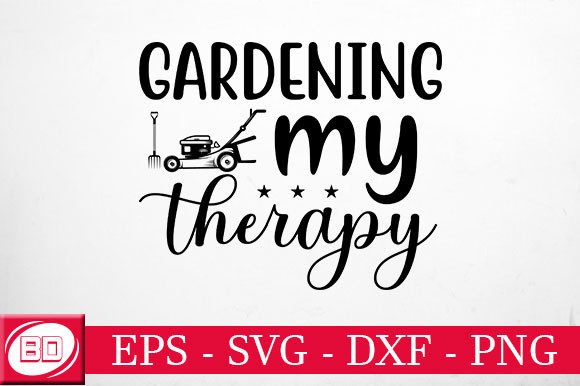
Gardening My Therapy Graphics for Crafts
As someone who’s shipped over 5,000 handmade items—from custom mugs and vinyl-tumbler wraps to seasonal printable bundles and craft-fair tote bags—I opened Gardening My Therapy with a mix of hope and healthy skepticism. This isn’t just another quote graphic. It landed with quiet confidence: clean lines, gentle curves, and a grounded rhythm that feels both intentional and soothing. It reads as rustic-elegant—think linen tea towels and kraft gift tags—not overly cutesy or aggressively modern. That balance is rare. It speaks directly to the mindful maker, the plant-loving Etsy shopper, and the customer who buys handmade not just for function, but for feeling.
Where Gardening My Therapy Fits in Real Handmade Workflows
I immediately dropped Gardening My Therapy into three live projects: a batch of sublimation mugs for a spring collection, a set of die-cut planner stickers for my digital product shop, and a Cricut project for heat-transfer vinyl (HTV) on organic cotton tees. In every case, it held up—not just aesthetically, but technically. The SVG design loaded cleanly into Design Space with no stray nodes or overlapping paths. No “ungrouping chaos.” The DXF file cut flawlessly on my Silhouette Cameo 4 at 0.25mm line weight. And the PNG design? Crisp at 300 DPI with true transparency—no fuzzy edges when layered over watercolor backgrounds in Canva or Illustrator.
This graphic design asset shines brightest where intention meets utility: on ceramic mugs (especially matte white or sage green), as a focal point on canvas tote bags, as a centered element on printable gift tags, and as subtle branding on thank-you cards tucked into handmade soap boxes. I’ve also used it successfully in tumbler wrap templates, scrapbooking kits, and printable wall art bundles—especially paired with botanical line drawings or minimalist garden icons. For craft fairs, I printed it on kraft sticker paper at 2.5” wide—it read clearly from six feet away and felt premium, not generic.
What Works—and What Needs a Craft-Savvy Eye
Gardening My Therapy excels in medium-to-large applications: 4”–8” cuts for vinyl decals, 6”–10” prints for greeting cards and framed art, and full-bleed layouts for printable planner pages. Its spacing and letter weight hold up beautifully in print-on-demand mockups—whether on Society6 mugs or Printful totes. As part of a seasonal design bundle (think “Spring Therapy Collection”), it pairs naturally with floral clipart, watering can illustrations, and soft serif fonts like Cormorant Garamond or Montserrat Light.
That said—be thoughtful about scale and context. At under 1.5”, the inner counter of the “g” and “a” starts to fill in on vinyl cuts, especially with thicker HTV. I tested it at 1” on glitter vinyl and scrapped that version—too much detail loss. Likewise, avoid layering it over busy patterns or low-contrast substrates (e.g., charcoal gray shirts without an underbase). And while the EPS file is great for vector scaling in Illustrator, don’t assume all layers are editable; I found the text was outlined—not live type—so font swaps require redrawing or pairing with complementary script fonts like Pacifico or Playfair Display.
Practical Crafter Notes You’ll Actually Use
- Always test before selling: Cut one SVG file on your machine first—even if it’s scrap vinyl. Check for tiny disconnected points or jagged corners.
- Preview PNG transparency: Drop it onto black and white backgrounds in your editing software. Does the shadow or stroke vanish? If so, adjust opacity or add a subtle drop shadow manually.
- Confirm resolution for sublimation: At 300 DPI and minimum 2400px width, this PNG design cleared my sublimation printer’s quality threshold—but always run a test print on transfer paper first.
- Check color fidelity: I swatched the greens and earth tones against Pantone guides. They’re warm and natural—not neon or oversaturated—so they’ll translate well across printers and substrates.
- Mock it up, don’t just imagine it: I placed Gardening My Therapy on real mug and tote bag mockups (using Smart Objects in Photoshop) before listing. Customers respond to realism—not flat thumbnails.
- Resize with purpose: On tumblers, I scaled it to 4.25” tall and added 1/8” bleed. On gift tags, I reduced it to 2.75” and tightened letter spacing by 10 units for visual cohesion.
- Licensing matters: This graphic design asset includes commercial license—verified in the download folder. That means you can use it in your Etsy product, craft-fair inventory, or client order without legal risk. Always double-check the license file before bundling it into a paid digital product.
Why This Graphic Design Asset Earns a Spot in Your Creative Marketplace Toolkit
Gardening My Therapy isn’t flashy—but it’s dependable. In a world of overdesigned clipart and AI-generated fluff, it feels human-made: paced, thoughtful, and emotionally resonant. It supports small business branding without shouting. I’ve used it as a subtle watermark on printable garden journal pages, as a foil-stamped accent on handmade seed packet packaging, and even simplified its outline for a single-color embroidery digitizing project.
For Etsy sellers building cohesive collections, it’s a quiet anchor—something customers recognize across mugs, stickers, and wall art. For Cricut users juggling dozens of projects weekly, it’s a time-saver: no tracing, no fixing broken vectors, no licensing guesswork. And for creative entrepreneurs launching their first printable design bundle? It’s a trustworthy foundation—professional enough for premium pricing, warm enough to feel personal.
If you’re curating graphics for real crafting—not just scrolling through endless listings—Gardening My Therapy delivers what matters most: clarity, versatility, and quiet confidence. It doesn’t ask to be the loudest in the room. It simply belongs—on your cutting mat, your mockup screen, and your customer’s favorite mug.